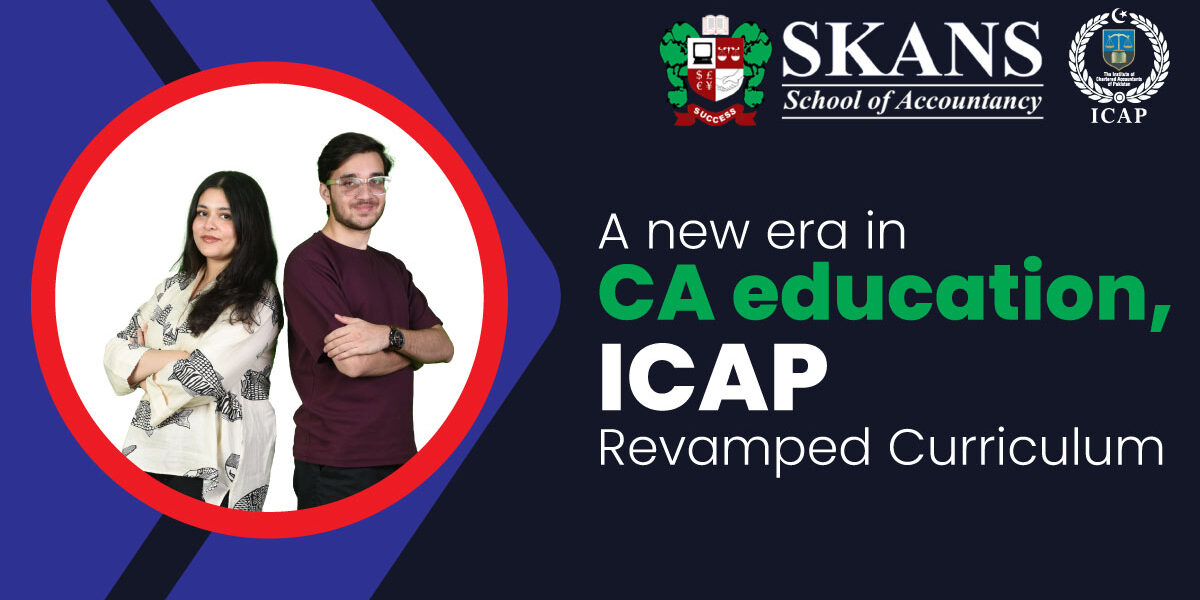
ICAP’s revamped CA curriculum aligns with global standards, tech trends, and modern skills, marking a new era in accountancy education in Pakistan.
The accounting profession is undergoing rapid transformation, driven by technological advancements, global integration, and evolving business models. In response to these dynamic changes, the Institute of Chartered Accountants of Pakistan (ICAP) has launched a revamped CA curriculum a bold, future-forward initiative that promises to redefine chartered accountancy education in Pakistan. This marks not just a change in syllabi, but the dawn of a new era, one that aligns CA education with international standards, industry demands, and the ever-evolving skill sets required by modern professionals.
Why the Need for Change?
For decades, ICAP has maintained a strong reputation for producing highly competent and globally recognized Chartered Accountants. However, the landscape of finance and business is not what it was even ten years ago. Automation, artificial intelligence, ESG (Environmental, Social, and Governance) reporting, data analytics, and a renewed focus on strategic advisory roles have reshaped what it means to be a CA today.
In this context, ICAP’s leadership recognized that staying relevant requires more than tradition, it demands innovation. The revamped curriculum reflects a proactive response to:
- Global shifts in the accounting profession
- Integration of technology in finance
- Evolving employer expectations
- The need for soft skills and real-world problem solving
- The demand for international recognition and mobility
Key Highlights of the Revamped Curriculum
1. Technology Integration
One of the most groundbreaking elements of the updated curriculum is the integration of emerging technologies. Courses now embed knowledge of:
- Data analytics and visualization tools
- Block chain fundamentals
- Artificial intelligence in auditing
- Cybersecurity awareness
These aren’t taught as standalone IT subjects, but are integrated into core accounting and finance courses reflecting how technology is embedded in real-world finance functions.
2. Enhanced Focus on Soft Skills and Ethics
The revamped curriculum takes a holistic approach to professional development. It now places greater emphasis on:
- Communication and interpersonal skills
- Critical thinking and decision-making
- Ethical leadership and professional integrity
These additions address a growing need for CAs to not only be technical experts but also effective leaders, advisors, and communicators.
3. Modular Structure and Flexibility
In a move toward global best practices, ICAP has adopted a modular structure. This allows for:
- Greater flexibility for students to progress at their own pace
- Better alignment with international frameworks, including IFAC’s International Education Standards (IES)
- Easier credit transfer and global recognition
This modularity also opens doors for collaborations with international universities and institutes, offering joint degrees, exemptions, or credit transfers.
4. Real-World Application and Case-Based Learning
Gone are the days of purely theoretical exams. The new CA curriculum introduces case-based learning, simulations, and scenario-based questions to ensure students can apply their knowledge to real-world problems.
This approach develops practical judgment, analytical skills, and the ability to adapt knowledge to dynamic business environments critical traits for the modern CA.
5. ESG, Sustainability, and Global Reporting
In line with global accounting trends, the updated syllabus now includes:
Sustainability accounting
- Integrated and ESG reporting
- Corporate social responsibility (CSR) frameworks
This prepares future Chartered Accountants to contribute to sustainable finance, an area of growing importance worldwide.
Impact on Students and Employers
For Students:
The revamped curriculum offers a more engaging, relevant, and flexible learning journey. It is designed to:
- Better prepare students for the digital economy
- Provide global mobility through internationally aligned content
- Foster lifelong learning and adaptability
- Offer a more student-centric structure, reducing burnout and improving success rates
For Employers:
Organizations employing ICAP-qualified professionals can expect:
- Graduates with up-to-date technical and digital skills
- Professionals trained in real-world scenarios
- CAs who can strategically contribute to business growth and transformation
- A workforce more aligned with international expectations and compliance frameworks
International Recognition and Strategic Vision
ICAP’s curriculum overhaul aligns with its strategic goal of positioning Pakistani Chartered Accountants as leaders in the global finance community. The new structure mirrors global benchmarks such as:
- IFAC International Education Standards (IES)
- ACCA, ICAEW, and CPA qualification models
- World Bank and international employer expectations
This alignment will enhance ICAP’s international standing, helping its members secure roles in top multinationals, Big Four firms, and regulatory bodies around the world
The Role of Technology in Delivery
Recognizing the evolving nature of learning, ICAP is also investing in digital platforms and e-learning resources. Blended learning models, virtual classrooms, and AI-driven performance analytics are becoming part of the CA journey.
This not only improves accessibility for students across Pakistan (including remote areas) but also enhances the overall learning experience and outcomes.
Challenges and the Road Ahead
No transformation is without challenges. The new curriculum will require:
- Faculty retraining and development
- Institutional upgrades in tuition centers
- Student mindset shift from rote learning to analytical application
However, with the right support, guidance, and industry collaboration, these challenges are surmountable. The benefits far outweigh the initial hurdles.
Conclusion: A Defining Moment for the Profession
The revamp of ICAP’s CA curriculum is a defining moment in the history of professional accounting education in Pakistan. It is not merely a syllabus update it’s a strategic reinvention of how future CAs are nurtured, trained, and empowered.
As the global economy continues to evolve, Pakistan’s accounting professionals must be ready to lead, not follow. With this curriculum, ICAP has sent a clear message: we are ready for the future.
The journey ahead will require commitment, adaptability, and continuous feedback, but the foundation has been laid. A new era in CA education has truly begun and it holds the promise of global excellence, leadership, and innovation.
The Institute of Chartered Accountants of Pakistan (ICAP) stands at the vanguard of shaping the nation’s financial landscape. As the world evolves at an unprecedented pace, so too must the education and training of its future leaders. Recognizing this imperative, ICAP has unveiled a comprehensively revamped curriculum, signaling a new era in CA education within Pakistan. This isn’t just an update; it’s a paradigm shift, designed to equip aspiring Chartered Accountants with the knowledge, skills, and foresight necessary to thrive in a complex, technologically driven, and globally interconnected professional environment.
For decades, the CA qualification has been synonymous with rigor, depth, and unwavering professional standards. It has consistently produced financial professionals who are not only technically proficient but also ethically grounded. However, the demands placed upon these professionals are no longer confined to traditional accounting and auditing functions. The modern CA is expected to be a strategic advisor, a data analyst, a technology integrator, and a leader capable of navigating disruption. ICAP’s new curriculum addresses these evolving expectations head-on, ensuring that its graduates are not just ready for today’s challenges, but are also future-proofed for tomorrow’s opportunities.
At the heart of this transformation lies a holistic approach that moves beyond rote learning and emphasizes critical thinking, problem-solving, and practical application. The new structure introduces a more streamlined yet comprehensive learning pathway, integrating contemporary topics that were once considered niche into the core curriculum. This includes a significant focus on data analytics, artificial intelligence, cybersecurity, and sustainability reporting – areas that are rapidly becoming indispensable for any successful business.
One of the most striking features of the revamped curriculum is its emphasis on digital literacy. The modern world is driven by data, and the ability to interpret, analyze, and leverage this data is paramount. Aspiring CAs will now be immersed in modules that teach them how to utilize data visualization tools, understand big data, concepts, and apply analytical techniques to derive actionable insights. This goes beyond mere familiarity with software; it cultivates a data-driven mindset, enabling CAs to contribute strategically to business decisions rather than just reporting on them. Imagine a CA not just reconciling accounts, but forecasting market trends using advanced analytical models, or identifying potential fraud through sophisticated data pattern recognition.